
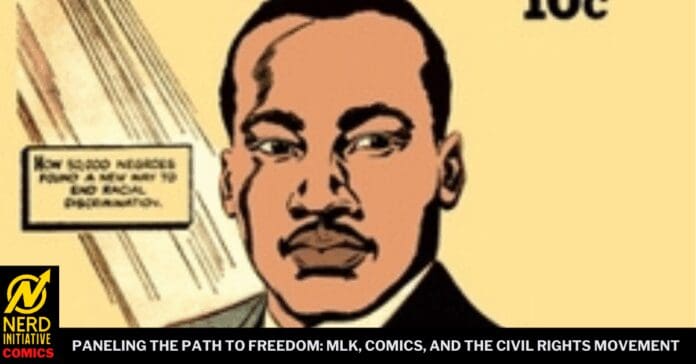
In December 1957, the non-violence pacifist group Fellowship for Reconciliation (FOR) published Martin Luther King (MLK) and the Montgomery story. This seminal work began the connection between comic books and the Civil Rights Movement.
Bypassing Barriers
On the tail of the highly successful Montgomery Bus Boycott, FOR Executive Secretary Alfred Hassler and FOR member Rev. Glenn E. Smiley came up with an idea. What if the story of the bus boycott (which FOR had played a role in organizing) could be brought to a wider audience? Smiley had been a participant in the bus boycott himself and struck up a friendship with Dr. Martin Luther King Jr.
When seeking the best way to tell the story, the men settled on a comic book. The group then approached potential investors with their comic book idea. The comic book Smiley and Hassler suggested would not only be cheaper to produce but would be able to bypass some of the educational barriers. Including low literacy levels, and allow the story to be told to a wider audience.
After securing $5,000 in funding, the creative team of Alfred Hassler, Benton Resnik, and an uncredited artist created the comic Martin Luther King and the Montgomery Story. While there had been rumors for years, it wasn’t until 2018 that we got definitive confirmation. This came from the man himself that Sy Berry was the uncredited artist all those years ago.
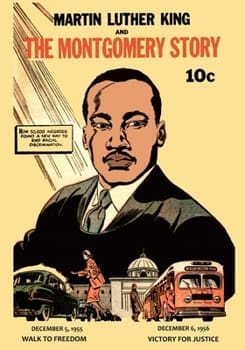
In December 1957, about 250,000 copies of the comic began to be distributed. Rather than the traditional method of newsstands or pharmacy shops, the comics were distributed to churches, schools, and civil rights groups. With Smiley giving the comics to young attendees of his speaking engagements throughout the south. The comic wasn’t just a biography, it was a manual, explaining the “Montgomery Method” of nonviolent resistance in simple actionable terms. Breaking the barriers of literacy that kept other informational pamphlets from being successful.
A Global Domino Effect
Decades later, the comic itself would be translated in Arabic and go on to serve as an important source of information on non-violent resistance during the Arab Spring events particularly in Egypt. Around the same time, the prevalence of the comic began to grow. Changes also started happening at the Big Two comic creators of Marvel and DC. Martin Luther King and the Montgomery Story showed that the comic book medium was missing out on groups of people who enjoyed the simplicity and portability of a good story.
Weeks after Dr. King’s “I Have a Dream” speech, Stan Lee and Jack Kirby would launch a rag tag group called the X-Men. While not originally a Civil Rights allegory, the 1970s would see writer Chris Claremont takeover the title and shift the struggle of mutants in the panels to being full on synonymous with the struggle of African-Americans in the United States.
In July 1966, Marvel Comics would release Fantastic Four #52 and with it, Jack Kirby and Stan Lee gave birth to the Black Panther. The shadow of Dr. King’s non-violence movement, the success of the FOR created comic, and the rise of the Black Power movement began to fundamentally alter the DNA of the industry’s biggest titans. Comics no longer had to be pure escapism, but could be used for serious education and social commentary.
In 1970, DC Comics would take a sledgehammer to their status quo with writer Denny O’Neil and artist Neil Adams leading the way. In Green Lantern #76, the current Green Lantern in the story, Hal Jordan, is famously confronted by an elderly Black man. Challenging how the stories of Hal and the Lantern Corp saving intergalactic races are told far and wide while Hal never bothers to help the Black people within the United States. The result was DC’s “God-like” heroes were forced to land their spacecraft and deal with domestic issues of racism, poverty, and drug epidemics.
The Torch Passes
56 years after the publication of Martin Luther King and The Montgomery Story, another seminal Civil Rights figure would turn to comic panels to tell their story. In August of 2013, The March: Book One, written by John Lewis and Andrew Aydin, with Nate Powell handling illustration and lettering, hit the shelves produced by Top Shelf Productions (now an imprint of IDW). Two more issues would follow in 2015 and 2016. Collectively, the March trilogy told the story of John Lewis.
It was a 15-year-old Lewis, getting his hands on the FOR’s Martin Luther King and the Montgomery Story comic that began to help him understand the principles of non-violence. A conversation with Aydin, a member of then Congressman Lewis’ communication’s staff set Lewis on the path to telling his story through comics. The books, published separately would go on to be collected into various formats such as trade paperbacks and hardbound books. To this day, March remains one of the highest rated comic trilogies in recorded history.
The Story Continues
So on this day, when the United States commemorates the work and life of Dr. Martin Luther King, we stop to acknowledge the role that humble comic books played in sharing his message of non-violence. We celebrate the power of a 10-cent book in the hands of a young John Lewis that would, in part, inspire him to a life of non-violence and commitment to the Civil Rights Movement through Selma and nationwide. Comics were, are, and will continue to be a way to break down barriers, have tough conversations, and discuss difficult topics in a way that reaches huge chunks of the population that may otherwise remain oblivious.
For more from Shawn at Nerd Initiative, CLICK HERE!
What are you reading on this MLK Day? Let me know in the comments below.

Leave a Reply