
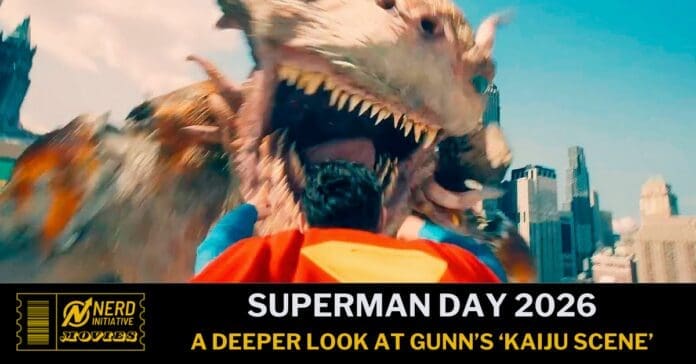
When James Gunn’s Superman hit theaters last July, it did so with overwhelming praise. I was one of its most vocal supporters, praising the curated reality of the film. Gunn succeeded by creating an Earth that wasn’t ours, thereby forcing us to imagine Superman not in our world, but making one for him that was definitely a place of fantasy and adventure.
Gunn’s Earth has shared its history with metahumans for centuries, so a character like Superman or Hawkgirl or Metamorpho doesn’t really phase its denizens. Even the Kaiju, which appears early on in the film as a distraction let loose by Lex Luthor, doesn’t seem to rattle the Earthlings in Gunn’s world as much as it would ours.
In retrospect, I wanted to take this Superman Day to address shower thoughts that had me take a more critical look… at myself. I was so quick to heap praise upon Gunn’s script and direction that I gave him a pass for scenes that I dismissed as filler, padding the runtime, and upping the action. However, as the film has spent more time in my head, I’ve begun to overturn stones and note that the filler isn’t just exposition or character-building – there may be a deeper, more sinister future for the Big Blue Boy Scout hidden in plain, popcorn-gobbling sight.
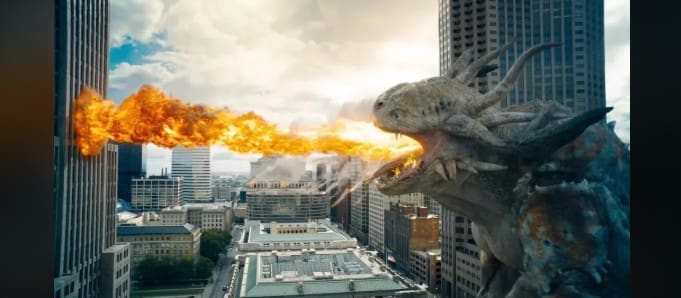
If you haven’t seen the film, then I’m not spoiling anything by telling you that there is a big action scene early in the film wherein Superman fights a giant, fire-breathing Kaiju. Even if you haven’t seen the relentless trailers depicting the fight, it’s still not a spoiler because the fight itself is inconsequential. Or is it? In-film, it’s a distraction by Lex Luthor as he works toward more nefarious purposes. Narratively, it’s an opportunity to show Superman’s propensity to help others and preserve life, as well as introduce the Justice Gang.
The scenes of Superman saving a dog, a squirrel, a little girl, an office full of onlookers, and even his admittance that he wants to save the rampaging creature itself all serve to illustrate his ethical code. It’s one long exercise in “Show, don’t tell,” which alone would elevate the scene’s inclusion above that of “filler.” But, as I’ve sat with it over the many months since first viewing it, I’ve noted that there is something even deeper being revealed by this scene. Something that elucidates how those in this world, friends and lovers, enemies and allies alike, see Superman.
Superman has always been a mirror for our own lives. Created by Joe Shuster and Jerry Siegel, Superman emerged as an invincible force for good who fights for his adopted home of Earth. His origins reflected Siegel and Shuster’s experiences as second-generation immigrants paralyzed by the fear of economic uncertainty and an encroaching global war. Since then, countless authors and artists have used the character to draw attention to universal and personal experiences of the human condition. One that has recurred recently is that of “passing.” Superman looks human, and that has allowed him to exist alongside humans, temper their fears, and find acceptance.
But he is not.
That’s when it hit me that there was something very interesting going on underneath the whole Kaiju fight scene. Superman says early on in the conflict that he wants to restrain the creature and release it elsewhere or study it, and this stance is either laughed off or bemoaned by the Justice Gang. Mr. Terrific, the third smartest man on the planet, hears this earnest plea of morality and mercy and responds by rolling his eyes and saying, “Come on, man!” He then leads the Justice Gang in battling the creature and even deals the final blow, flying his T-Spheres into the creature’s belly and exploding them from within, killing it.
When Superman voices his dismay at this brazen act, he is told by Guy Gardner, “Don’t be such a wuss.” Guy, Mr. Terrific, and Hawkgirl didn’t think twice about killing the creature because they only saw its otherness. As they similarly disregarded the safety of the previously mentioned squirrel, the Justice Gang arrives to fight monsters and save people, making those distinctions on superficial evidence and snap judgments.
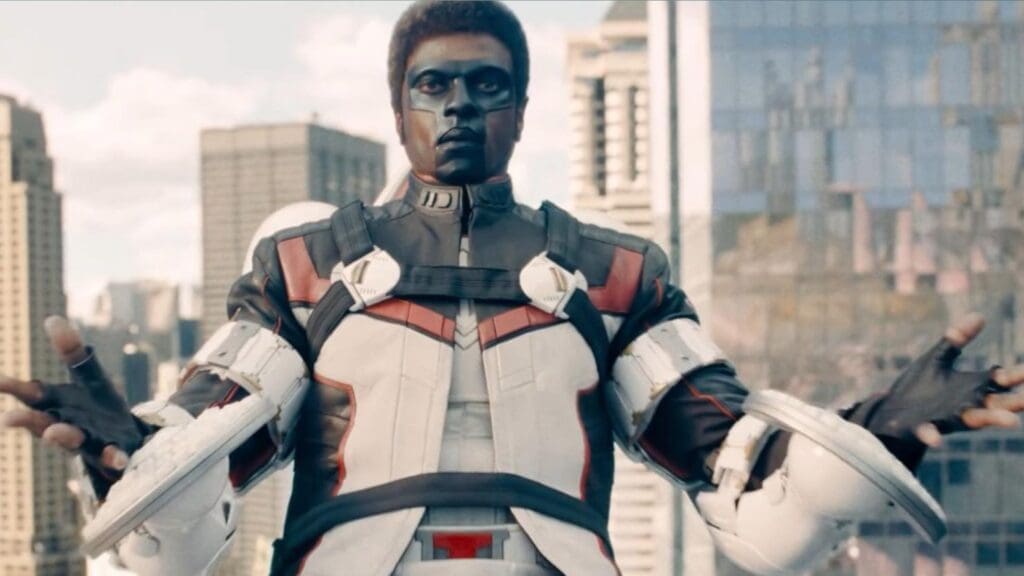
What unsettles me about this dichotomy of the Justice Gang mentality and the morality of Superman is Mr. Terrific’s role as executioner and his status as the third smartest man on planet Earth. If Mr. Terrific can accept the mathematics of killing a creature to save human life, then it’s a short bridge to killing Superman. Viewing the scene in this light, it not only serves to illustrate Superman’s virtue but also might give us a glimpse of his future adversaries. Even Guy Gardner, barely a scene later, admits to Supes, “If any of that message is even remotely true, then you are exactly the kind of alien threat I was commandeered by the Green Lantern Corps to protect this planet against.”
Is James Gunn playing a long game with Superman and the Justice Gang to come into conflict with one another? Will Superman’s “passing” fall away, revealing him as just another “alien threat?” And when that happens, will Mr. Terrific hesitate to kill him to save humanity?
Or was it all just a fun action sequence to add some color, fire, and fun animal rescue to a summer popcorn flick? What do you think? Either way, enjoy Superman Day and celebrate the Man of Steel for whatever deeper beacon of humanity you find him to be.

Leave a Reply