
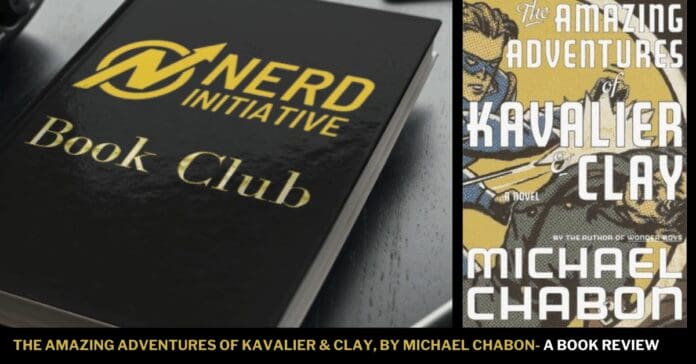
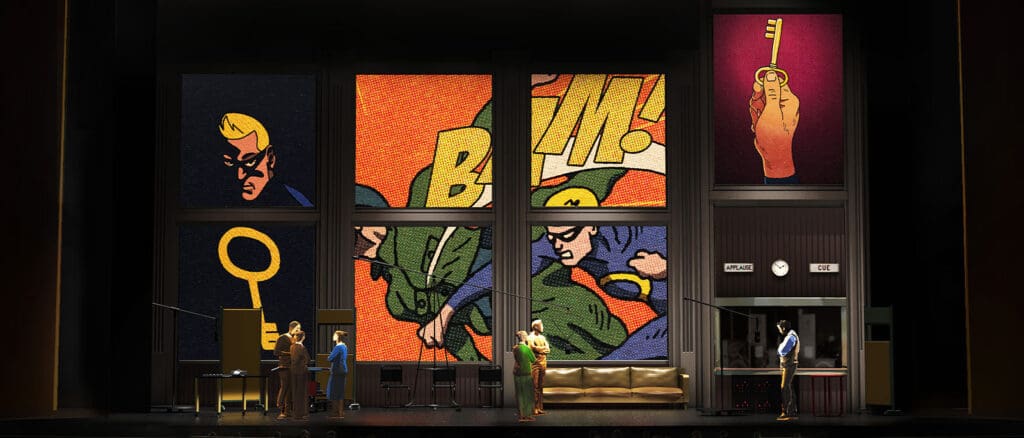
Michael Chabon’s The Amazing Adventures of Kavalier & Clay is the author’s third novel and the 2001 Pulitzer Prize winner for Literature (Fiction). Chabon’s previous novels, The Mysteries of Pittsburgh and Wonder Boys were both made into films, and The Amazing Adventures of Kavalier & Clay has been circled by Hollywood even before its completion. As yet, it has only been adapted into an opera, which began runs at the New York Metropolitan this past September and will return for four days in February. Early response to the opera has been mixed, and I missed its initial run, but perhaps I’ll see it when it comes to cinema in January, or even try to catch it on stage in a few months. Chabon also served as showrunner and head writer of the Paramount+ event series Picard, starring Sir Patrick Stewart as the venerated Starfleet captain.
The Amazing Adventures of Kavalier & Clay is massive — a 600+ page tome that comes in at over 216,000 words. Those words are not elementary, either. I’m not the most loquacious or erudite man to walk the Earth and I found myself raising my eyebrows quite a few times as dollar words buzzed past me. I inferred most through contextual clues but out of shame and curiosity started Googling them as I got deeper into the narrative. If you’re brushing up for a standardized exam, this might be the book for you.
This is not to say that Chabon’s book is stuffy or highbrow, however. Though it is classified as historical fiction, and deservedly so as it is so thoroughly researched and detailed, the backbone of the book is the burgeoning comic books industry. Beginning in 1939, we are introduced to Samuel Klayman and Josef Kavalier, a pair of Jewish cousins with roots in Prague who team up to create a comic book hero and make a name for themselves. Peddling their idea to their novelties dealer bosses, the boys are given the greenlight to create The Escapist, the superhero alter ego of a lame boy who can escape any confinement while battling a secret evil organization engaged in world domination.
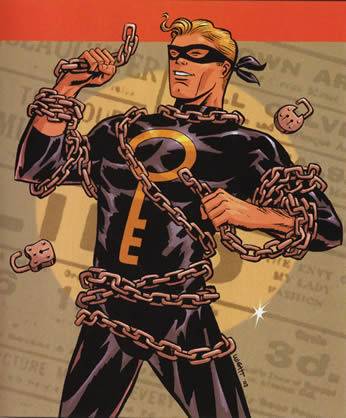
Joe Kavalier has emigrated to New York through the hard work and sacrifice of his family, which he is forced to leave behind in Prague just as the German Wehrmacht is making its way over the ravaged country. Landing on the miniscule doorstep of the Klaymans, Josef is taken under Sammy’s wing and brought in on his grand plans; Sammy is a writer, and he has ideas that will whisk him away from poverty and obscurity into fame and fortune. Josef sees in The Escapist a way to elucidate Hitler’s evil and stir up anti-Nazi sentiment in American readers. His artwork features The Escapist punching Hitler on its cover two full years before Captain America, much to the chagrin of financiers, advertisers, and marketers to foreign buyers.
What begins as a tale of two idealistic young men becomes the history of a nation and an industry. In the fictional world of The Amazing Adventures of Kavalier & Clay, Superman is already an established sales phenomenon. The basis of which drives creators and retailers (mostly retailers) to endeavor to match its grandeur. Fictional artists and writers pal with real artists and writers of the era, just as magicians, politicians, and actors within its pages. The Escapist begets comrades and spinoffs and soon an entire comics empire, befittingly called Empire Comics.
The Escapist is a huge success, and Empire Comics (and Novelties) are raking in dough faster than they can clamp their hands over it. Sammy and Joe are paid well, though a pittance in comparison to the characters’ success. If you’re thinking of Jerry Siegel and Joe Shuster, you’re on the right path. The reason I decided back in June to read this book for the Nerd Initiative Book Club was its core theme of immigrant creators making the most iconic American hero while themselves having to fight for every scrap, right, and accolade along the way. In this respect, it did not disappoint.

Chabon’s attention to the industry of comic books is not surprising — he’s been a scholar of the medium all his life. What is surprising is the level of detail brought to locations in Prague, the community of magicians and escape artists, New York Bohemia in the late 30s and early 40s, and even the minutiae of an Antarctic radio outpost in World War II. The boys run the gamut of the Golden Age of comics from assembling their artists, fleshing out their rosters, licensing lunchboxes and keychains, dramatizations for the radio, television and film adaptations, and all the way to the Kefauver Senate hearings. For those who don’t know, these were the dog-and-pony trials brought against comic creators, stirred up by the fervor of Fredric Wertham’s The Seduction of the Innocent. You can thank this real-life historical drama for the Comics Authority Code.
While the novel deals with the world’s (and America’s) descent into war, as well as the expansion and reaction of popular pulp comics, it also deals with two boys becoming men at a time when tomorrow always loomed as a question rather than an absolute. Josef spends most of the novel with a singular purpose: to protect his family from the Nazi scourge. He first does this by vilifying the Third Reich in the pages of The Escapist, then by taking to the streets and starting fights with bigots. He considers joining the fight directly when he gets even the slightest pushback from his publishers or Sammy. Eventually he meets Rosa Saks, a charming ingenue of bohemian stock who allows the light of love to shine into the cracks of his soul. Sammy, however, is singularly driven by another purpose — to be the best writer he can be and steward The Escapist into his rightful place in publication history.
The cousins largely agree on matters of story and direction, making for little drama in their professional partnership. They differ only on matters of execution, which drives an occasional wedge between them. Never deeper than the book’s third act. I will admit that by the time I was a hundred pages from the end I was eager for the novel to find its conclusion, and once it did I found it rather underwhelming. We’ve been with these characters for fifteen years and five hundred plus pages, so as we near the end we’re hoping for something fittingly epic to punctuate the tale. But, like many American lives, they seem rather to meander into irrelevance, bobbing silently on the waters of time, sending the slightest ripples from one end of oblivion to the other. I don’t know quite what I was expecting but it wasn’t that.
Overall Score: 9/10
That said, The Amazing Adventures of Kavalier & Clay is a must-read for fans of comic books, particularly the history of, and for readers eager to find a finalist for The Great American Novel. Michael Chabon has made heroes of ordinary men with extraordinary imaginations, a feat that stands as a testament to his own. He has also authored several Escapist comic issues, published by Dark Horse Comics. I highly recommend this great novel to anyone who wants a bit of instruction with their leisure and enjoys the intersection of the profane with the sublime. It’s often funny, surprising, and ultimately grounded in a humanism that can often get lost in genre fare. It may still emerge as a film or limited engagement series one of these days, so watch this space in the event that ever happens.
Of course, always check back here for more book reviews, and we’ve got all your comics, movie, and wrestling news and reviews here, as well. Let me know if you’ve read The Amazing Adventures of Kavalier & Clay and what you thought of it, and if you have an idea for our next book review, sound off below.

Leave a Reply