
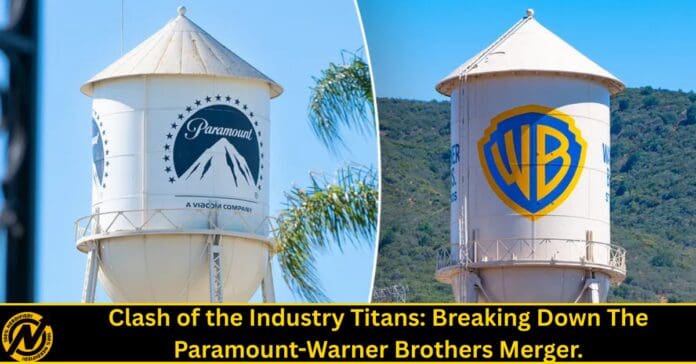
The Paramount and Warner Bros. merger has been put on hold by a multi-state lawsuit, throwing the future of Paramount’s ambitions and Warner Brothers itself into June of 2027. Hollywood loves a clash of titans, however, and while audiences might prefer battles between giant kaiju and superheroes, this antitrust lawsuit and its history are far more interesting. Let’s break down the lawsuit, just what’s at stake, and how this is a positive strike for the entertainment industry.

WARNER BROTHERS AND PARAMOUNT: THE MERGER
September 2025. Warner Bros. CEO David Zaslav had a problem: The studio was too big.
After a storied history with the company beginning in the 2000s, Zaslav planned to separate the company to increase efficiency and maximize creative endeavors in “the evolving media landscape.” On September 12 2025, Paramount Skydance made an unsolicited offer to buy Warner Brothers despite the studio not being (at the time) for sale.
Generating a great deal of industry concern, Warner Brothers opened the company to formal bids on October 21, 2025. 2025 ended, and 2026 began with two main bidders in final negotiations, Netflix and Paramount Skydance. The news caused a great deal of concern in industry circles, with artists citing a lack of jobs, unique projects, and opportunities, with fewer studios to work for. Hollywood audiences love a clash of titans, and while audiences might prefer superheroes or monsters, businesses and boardrooms hold far more sway over culture, news, and influence.
Netflix and Paramount Skydance emerged as the dominant bidders for Warner Brothers out of a lineup that included Starz (Lionsgate), Comcast (NBCUniversal), and Netflix and Paramount. Starz was eliminated early, leaving Comcast hoping to acquire and combine parts of the studio with its own network. Netflix hoped for the streaming and content libraries, while Paramount Skydance wanted to acquire all of it, from streaming content to news networks.

Paramount Skydance has something of a contentious history. The studio merged with Skydance under CEO David Ellison in 2024. Paramount Skydance’s merger earned the ire of critics, including Stephen Colbert, when it chose to settle a CBS lawsuit with United States President Donald J Trump in an effort Colbert himself called “a big fat bribe.” Paramount has denied it, calling it a business decision. Paramount Skydance saw itself as an early contender against Warner Brothers, hoping to build a media giant that could rival Disney.
Netflix had less lofty goals, only hoping to gain access to streaming content and its thousands of hours of programming. The streaming giant demonstrated no interest in the news networks or sports programming that Warner Brothers had produced. Paramount raised its bid to cover the entire studio, leaving co-CEOs Ted Sarandos and Greg Peters bowing out after Warner Bros. asked if they wanted to match Paramount’s offer.
Movie studios are like treasure chests; each one holds different artifacts that matter to audiences. Warner Brothers is no exception, with a catalog holding things like Harry Potter and DC Comics, along with Adult Swim and the Looney Tunes. Warner Brothers Discovery owns CNN, one of the most influential news networks on the planet. Paramount was determined to have it without considering the cost to the artist or the consumer.
ARTISTS FIGHT BACK HARD
From creatives like Mark Ruffalo to Denis Villeneuve and unions like the Writers Guild of America, over 5500 film and television professionals signed an open letter urging regulators to block the merger. The argument is that fewer studios would likely reduce opportunities for artists to work in the industry. With business moving overseas, it would be a massive contributor to damaging America’s film industry as a whole.
They were joined by California Attorney General Rob Bonta, who announced he was filing an antitrust lawsuit to block the 111 billion-dollar merger, calling it “a check on the oligarchy.” California, acting as the lead plaintiff, worked with eleven other states, including Arizona, Colorado, Connecticut, Massachusetts, Minnesota, Nevada, New Jersey, New Mexico, New York, Oregon, and Washington.

After District Judge Araceli Martínez-Olguín initially blocked the order for 2 weeks, Paramount agreed to delay the merger, saying they wanted their day in court.
“This is the fastest and clearest way to prove that this transaction is good for competition, good for consumers, and good for creators, a conclusion dozens of competition authorities around the world have already reached. We look forward to proving our case at trial.”
California AG Bonta released a statement on the merger calling it, “ great news for audiences, movie theaters, and the many people who write, build, and create the art, news, and entertainment so many of us enjoy.”
“We are eager to continue to make our case in court and celebrate another tremendous win in our effort to ensure this unlawful merger never sees the light of day,”

THE 2018 DISNEY-FOX MERGER.
This is not the first major studio merger that Hollywood has encountered. The Walt Disney Company’s 71 billion dollar deal to buy Fox Studios triggered a Department of Justice review that resulted in Fox having to sell off their Regional Sports Networks (RSNs). Disney, already owning ESPN, would have unfair dominance over sports coverage. The Department of Justice approved the merger if the RSNs were sold and Disney gained the rights to the X-Men, the Fantastic Four, the Alien franchise, and more. Fox News and Fox Sports became a part of the newly created “Fox Corporation,” now wholly owned by Rupert Murdoch.
The difference between these two mergers is interesting because it has to deal with just what Paramount is asking for compared to Disney. Disney’s bid was similar to Netflix’s – thinking solely of content. Paramount Skydance’s primary goal is scale. The idea would be that everywhere you turn, you would see Paramount Skydance attached to a familiar face like Bugs Bunny or Superman. While Disney’s merger significantly reduced competition in Hollywood thanks to owning a 100% stake in Hulu after buying out Comcast’s share, owning National Geographic, and much more, Paramount Skydance adding Warner Bros. ‘ crown jewels to their treasure chest would build a significant contender to the house of Mouse.
THE CREATOR OWNED LANDSCAPE
Media is constantly evolving. As studios embrace new technologies daily and new content engines like K-Pop Demon Hunters for Netflix or The Backrooms for a rising indie studio like A24, the relationship between studios is consolidating while a trend returns – the opinion of the audience.
The rise of social media and individual content creation has led to fans being able to speak directly to creatives of the properties that they love. This isn’t a new paradigm for Hollywood; in the 1920s, creators like Walt Disney, Charlie Chaplin, and Buster Keaton were able to speak directly to fans. A long shot doesn’t erase the role of the studio, but creators have once again become the public face of their creations to fans like the early days of Hollywood.
This is a large part of what helped delay the Paramount / Warner Brothers merger. Actors and creatives were able to directly appeal to the fans of the work that they created. This generated interest, and fans became aware of a clash of business titans that would reshape the Hollywood landscape once again, with fans able to advocate alongside artists.
The studio system is very much a part of content creation; it becomes dangerous when studios become monopolies. Antitrust laws prevent that. Antitrust laws are defined as regulations designed to promote free and open competition in the marketplace by preventing monopolies and anti-competitive business practices. Corporations are built to make money and be business titans. In an ironic twist worthy of a Hollywood movie, the Paramount/Warner Brothers merger has revealed that the way to end the epic clash might be the ordinary protagonist – the audience member – observing from afar and having a say.
What do you think about the merger? Let us know below!

Leave a Reply