
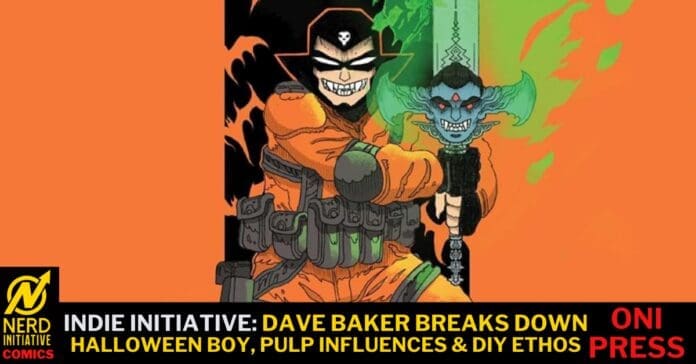
On the surface, Dave Baker’s resume in comics seems like it’s all over the place, jumping back and forth between smaller, more personal stories like Forest Hills Bootleg Society, Everything is Tulip, and Punk’n Heads, written with his frequent collaborator Nicole Goux, or his love letter to serialized adventures with Mary Tyler Moorehawk and Halloween Boy. Sprinkled in with some opportunities to play in the sandbox of some pretty respectable franchises, you can see Baker’s range and the reverence he has for the medium. Oni Press has collected the first five issues of Baker’s independently produced comic, Halloween Boy.
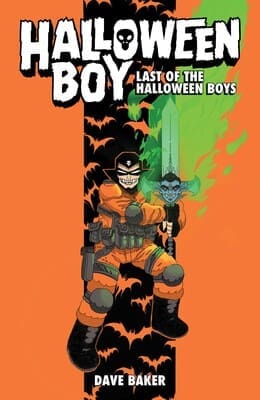
Halloween Boy came about after his pitch for some classic pulp heroes wasn’t accepted by their rights holders. With his vision intact and time on his hands, Baker pivoted to an original story: an homage to the globetrotting and pulpy serials of the 1940s, with a tinge of horror. Using his DIY sensibilities, Baker decided to do as he had done many times before and self-publish. As you will read below, Dave Baker remains humble but vigilant in an industry that has a history of not always treating its creators well.
(Edited for Clarity)
I enjoyed Halloween Boy. It was super cool.
Thank you very much. That’s very nice to hear.
What did you do to get into comics?
I started self-publishing in high school, and basically ever since, I’ve just been kind of making things on my own and slowly submitting them to publishers. And over the years, people have deemed the work worthy, I suppose.
Who do you feel are your biggest artistic and writing influences?
For art, it’s definitely Katsuhiro Otomo, Hergé, Geof Darrow, and Shotaro Ishinomori. For writing, David Foster Wallace, Matt Fraction, Mark Z. Danielewski, Jillian Tamaki. I don’t know. There are just so many, you know. I like talking about influences. I know some artists don’t. I think it’s fun. I will say that it is something of a reductive process to try to distill everything to this one spark of inspiration.
You’ve played with pop culture tropes in your indie work, but I’ve also read your work that you’ve been hired on for (Star Trek, Godzilla, Teenage Mutant Ninja Turtles). Which do you prefer more: working within those confines or kind of working on your own?
They’re two different things. I like working in the work-for-hire system because it’s fun to try and see what you can get away with. It’s fun to touch the toys that you grew up with. I love Godzilla, Star Trek, Turtles, and you know, Batman, and Superman. I like doing that stuff, but it is a different skill set and one that I have a lot of respect and reverence for.
It takes a specific type of person to be able to thread that needle and bring their voice to a property that’s been around for some fifty or a hundred years and bring something new, but also make it still feel like a piece with the other stuff. I think in terms of what I like, I don’t think I was put on this earth to write Harley and Poison Ivy. As much as I enjoyed that, I think I was probably put on this earth to tell my own stories. So that to me is the reason to do it. I like doing that other stuff, and I take it very seriously, but I obsess over the creator-owned work that I do.
What is the creative journey for Halloween Boy?
I had just sold Mary Tyler Moorehawk to Top Shelf, and I was in the process of trying to figure out what my next project was going to be. I was talking with King Features, the rights holders to The Phantom and Flash Gordon. I was kind of pitching them on an idea to give me the rights to both of those characters to make indie comics-centric versions of them.
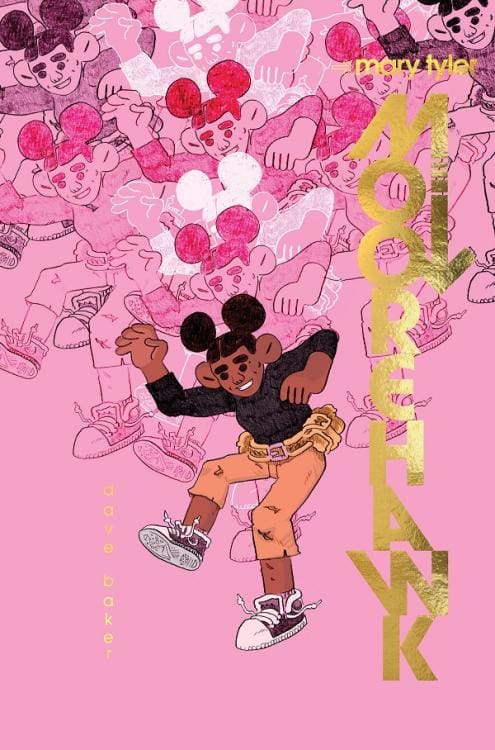
We had some discussions; it got up the chain and then ultimately ended up not happening. I basically had a year between when Mary Tyler Moorehawk was going to come out and when I was going to have to start doing press. So I was like, what am I going to do with this year?
I guess I’ll just make my own version of those Phantom comics that I had been pitching. That started me on this kind of sojourn, so to speak, of trying to figure out how to make a contemporary superhero that works. It’s really hard to make a new superhero. There are lots of brilliant attempts at it, and most of them have not succeeded very well. It’s not for me to say if mine succeeded, but I took the good old college try, you know?
There’s a very Saturday serial matinee vibe, and it was similar to Mary Tyler Moore in places.
Halloween Boy is in Mary Tyler Moorehawk in a couple of places. He’s on the inside front cover. He’s also in episodes of the fake TV show. There’s one episode that he’s a guest star on. It’s like a Bridge Over the River Kwai parody where he’s the demolitions expert or something. I can’t really remember. Then, in Halloween Boy, there are multiple characters from MTMH. One of the big supporting characters is Dreeb Lazenby, who’s a supporting character in Mary Tyler Moorehawk. Yeah.
I like the idea that, even though these books are put out by different publishers, and there’s kind of a standalone quality to both of them, there’s a shared universe. Some of my other graphic novels, the characters are in both of those books, and vice versa, they’re in some of the other books. I like the idea that it would be a weird little shared universe that doesn’t really need to be read in any order.
If you’ve read a bunch of the books, there’s a shared continuity and a shared creative ethos to them. Yeah, I don’t know. I’m a big fan of people like Farel Dalrymple, Michel Fiffe, or Benjamin Marra. Those guys do a lot of similar work where they have characters pop up and reappear. You don’t necessarily need to know who they are, but if you do, it enriches the reading experience. I think you also spend so much time alone thinking about these things, they become real to you. Like, the characters stop being drawings and start being weird two-dimensional friends. There’s a component of it that’s like, “Well, I can’t go to a party alone. I’ve got to bring my homies,” you know?
There are seven issues altogether, but this one only has five, correct?
Yeah, I’ve drawn up to thirteen, but I’ve only published up to seven. You kind of have to slow-roll things a little bit when you’re self-publishing because people just sort of take it for granted. They’re like, “Well, I’ll just buy the trade.” I’m like, “There’s not going to be any trade if I don’t sell these issues, my guy.”
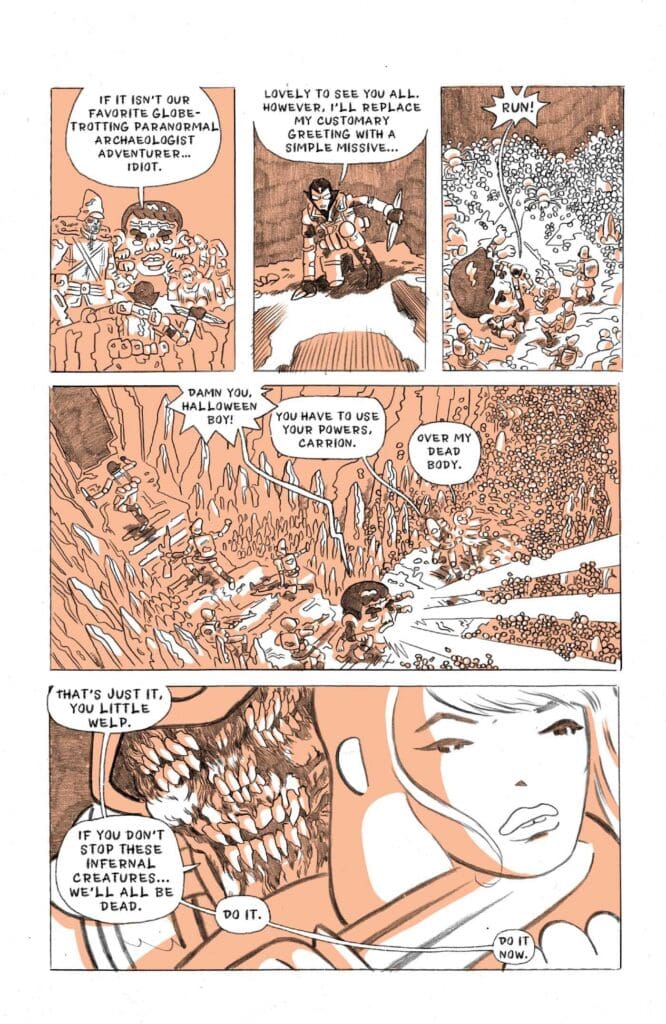
The collection that Oni is putting out is the first five. It’s the first arc, “Last of the Halloween Boys.” It’s both like an in media res, picking up with a character who’s existed for a long time, but also kind of like a soft origin where you see him building out a structure of supporting characters. You get to see the world and how his impact on it is changing and developing things. In a quintessential comics fashion, there’s a twist where characters from the past show up with grievances and flaming swords and armies of skull-themed soldiers.
The monsters you draw are so cool, too. They’re fantastic. All different sizes of monsters, too. And I love that there are six-foot monsters and kaiju-sized monsters.
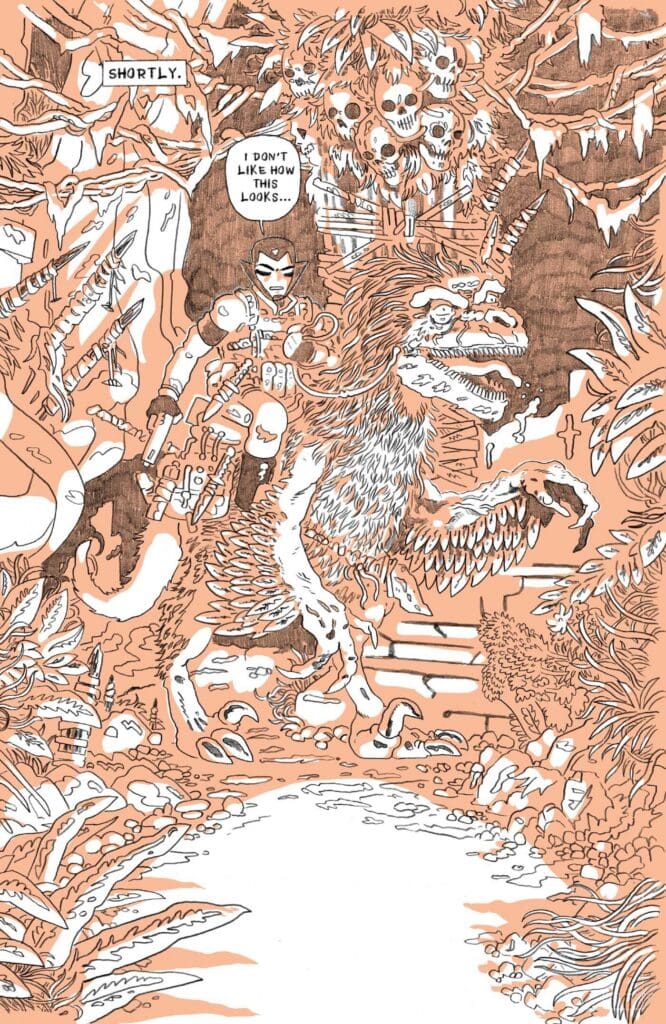
I have been accused in the past of drawing in a toyetic fashion, and that is not something I do intentionally. That’s just the way my brain works. I grew up loving toys and collecting them. I think of myself as a character designer first, and then a cartoonist second, maybe. I don’t know if that’s necessarily true, but I think you’ll know what I mean when you can see it in the books. There’s like a tuxedo Dracula samurai, you know, robot alligator or whatever.
Do you have an endpoint?
I think thirteen is going to be the last one for right now. If it does well and people really like it, I would love to do more. I think for right now, thirteen is probably the end of it. It’s a nice, solid little chunk, and I can go away and draw some more stuff and do something else and then come back to it.
You mentioned you slow-release them. How often do you release the issues?
It kind of depends. Usually, I would say once a quarter, maybe once every six months. It’s really just how much the previous issues have sold that dictates what I print next.
Do you wait until you hit a number, and if you hit that quota in two months or three months or however many months, you just say, “I got my print money”?
Basically, yeah. Once I hit a certain amount of sales, I go, “Now there are enough people that are going to have the previous one to be able to buy the next one.” I’ll print that one. It’s usually timed around conventions. A lot of times, I put new issues out around San Diego Comic-Con, New York Comic-Con, or maybe Emerald City. It helps with the bottom line of tabling as well.
For these Johnny Quest, Indiana Jones-type stories, what sticks out for you about them?
I love globetrotting. I’m from an area where nothing really happens, so the fantasy of that, I think, is particularly alluring. As an adult, I’ve traveled quite a bit, and I really like other cultures, seeing places, and meeting people. I’m a criminal extrovert, and my comics reflect that to a large degree. I also love the tropes of the genre and how interesting they are to kind of wax and wane against, and how a lot of people have forgotten the origin point of some of those tropes. In Mary Tyler Moorehawk, the opening sequence is a pretty direct riff on Raiders of the Lost Ark.
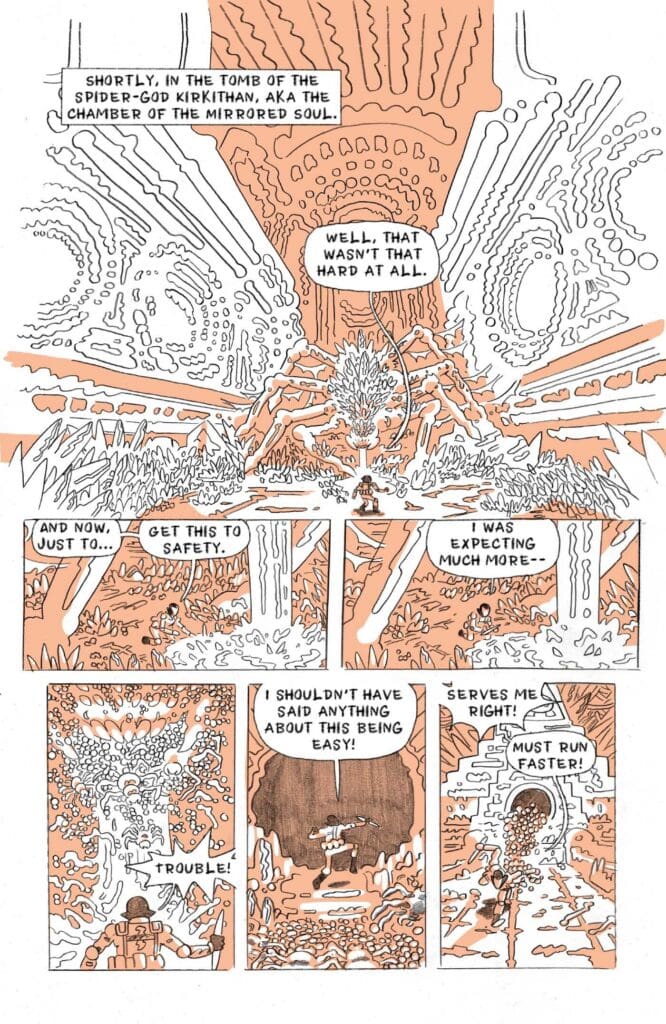
We’re making a parody because this is the only thing people know about adventure stories. Doc Savage, or the Phantom, or Robinson Crusoe, even Swiss Family Robinson, they’ve all kind of faded from the popular consciousness in the way that they once were. I mean, it’s an interesting game of telephone in the same way that Star Wars is Flash Gordon. George Lucas wanted to make a Flash Gordon movie, but couldn’t get the rights, and made Star Wars. That’s one of the things that I took a lot of inspiration from; I wanted to make the Phantom.
What does the Phantom look like if I’m George Lucas today? Like what elements of the Phantom am I keeping? What elements am I throwing away? What am I evolving? How am I repositioning things to make it a larger canvas and to make it lived in? You know, like I love Star Wars, but it’s pretty direct, what if Dune and Flash Gordon had a baby?
Do you write for readers who grew up with that genre, or are you trying to introduce it to a new audience?
I think a little bit of both. I don’t think there are a lot of people who grew up with that adventure genre who are below the age of ninety now. So, there’s a component of it that is like, I love those stories, and I’m something of an old soul. I did grow up watching old forties and fifties Western TV shows. I was obsessed with King Solomon’s Mines and The African Queen. I’m also a person alive in 2026, and I’m keenly aware of the racist lineage of a lot of those things.
That’s a core component of the book as well. I wanted to deliver on the premise and the promise of the genre while also reapproaching the genre and being like, “Yeah, there’s some stuff here that we should acknowledge.” I don’t know if that succeeds or fails; that’s not up to me to decide, but that was kind of my thought process going in.
How do you balance homage with creating something new?
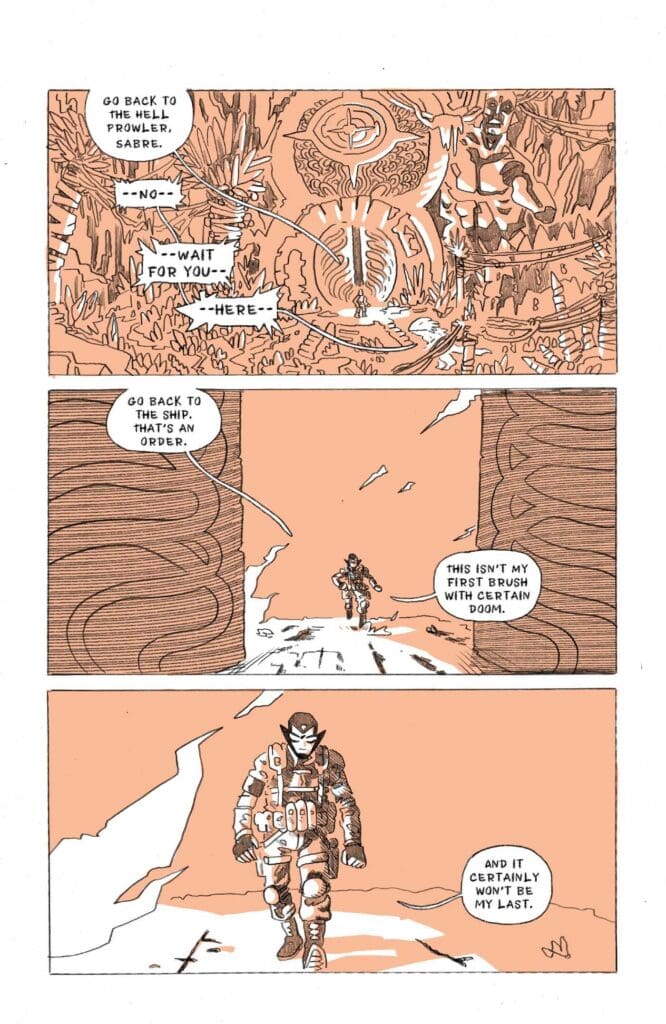
I think the issue there is finding a path through the minefield of derivativeness; that’s the key. If the thing you’re paying homage to is helping and is core to the underlying metaphor of whatever you’re making, and making it feel more personal, then I think that’s good. If it’s holding you back and making it feel like something that has previously existed, and if the only reason it exists is to point backward as opposed to inward to you and serve as an undergirding of the spiritual or emotional moment the story is attempting to excavate, then that’s when I would say it’s probably not a great idea. I mean, the book is filled with homages.
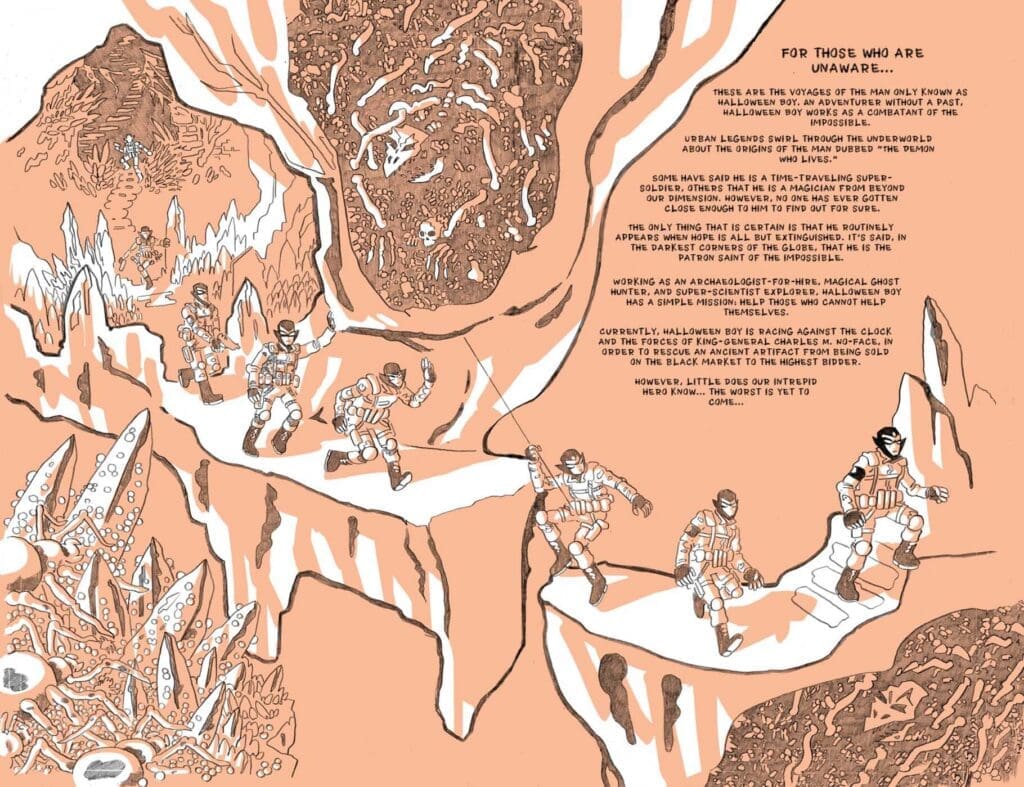
I mean, even just the fact that it’s “man of a thousand fates,” “the demon who lives,” those are pretty direct riffs on the Phantom’s catchphrases, “the ghost who walks, the man of a thousand deaths.” That’s kind of funny that they’re so direct and that it sets up a specific kind of rubric for the reader, if you know those things. Then, the story being hopefully really personal and emotionally complex, it actually helps undergird that stuff, but again, that’s not really for me to say. That’s more for a reader.
So you draw, you write, color, draw, and letter everything in duotone. How does working entirely solo shape the storytelling?
I can only write things that I want to draw. If I were working on one of my other projects with one of my other collaborators, most notably Nicole Goux, I could draw laser swords and talking dinosaurs and flame-filled post-apocalyptic cities. She doesn’t want to draw that. It’s all interior bedrooms and sad, crying, teenagers.
Which is honestly probably what I normally would want to write anyway. That’s where my brain usually goes. I am not a skilled enough illustrator to make that interesting. I gotta have some machine guns and robot arms. It’s about being able to build a story out of things that I am interested in spending fifteen to twenty hours drawing.
Is one more satisfying than the other, or is it kind of a yin and yang for you?
It’s a little bit of both. I think there is something to be said for a complete vision where you’re building out a world that you’ve made every choice over. That being said, I also love not having to draw everything in the other books.
How long does it take you to draw an issue of Halloween Boy?
I draw about four pages a day. It just depends on what level of crazy I’m going to be, because some of them are oversized in that they’re like 32, and some of them are oversized in that they’re like 64.
It’s like a two-hundred or three-hundred-page book?
Yeah.
How much of Halloween Boy or Mary Tyler Moorehawk is autobiographical versus the kind of smaller stories you write with Nicole?
I would say all art is autobiographical to some degree. However, I don’t think that I have a robotic arm or have ever wielded a flaming demon skull sword. I think of those ideas as metaphors. Anytime a character is riding an anthropomorphized nine-foot-tall bat is the same as going on a quiet car ride in another type of comic. You’re slotting in the visual metaphors or visual tropes of a genre in order to accentuate a personal statement. I’m pretty proud of the work I’ve done with Nicole. I’m also thrilled that I’ve been able to draw the things that I have. My body hasn’t given out yet.
That’s always good.
Every day is a little closer, you know what I’m saying?
What has the self-publishing experience taught you that work-for-hire hasn’t?
That the cavalry is never coming. There is no support. There is no second line of defense. It’s all you. Even when it’s working on some Big Two thing or working on Star Trek or whatever, I’m the one who does the marketing. I’m the one who goes out and pitches editors things.
I think that’s the ultimate lesson of starting as a DIY self-publisher: if you want to do something, it’s up to you to do it. There isn’t going to be something that reaches out to you and says, “Here’s the thing that you’ve always wanted.” You actually have to go out and do it.
There’s no village. How do you handle the marketing and distribution side of things? Do you send everything out and mail everything yourself?
A hundred percent hand-mailing it, packing the packages, running the Kickstarters. I have an automated spreadsheet of about 2,500 retailers. I send query emails every time a new book comes out. I post on social media as much as possible. That’s the thing, you can always be doing more, so you have to allow yourself. I’m doing as much as I physically can. I’m not going to try and beat myself up over the fact that I am not doing as much as I feel like I should because there’s just, there’s only so much you can do, you know?
You only have so much time in a day. What’s your advice for indie creators thinking about self-publishing?
Start small. Make mini-comics. Don’t start with a 500-page magnum opus. Get a bank account. Find a collaborator. Go to local conventions. Meet people. Be nice. Have business cards. Introduce yourself when you’re tabling. Stand up. Don’t sit down. Don’t draw at the fucking table. You draw at home. Stand up. Talk to people. Be chill. Don’t be an asshole.
When Nicole and I first started tabling, the difference in sales we saw when we stood versus sat was, you know, very large. Especially once we figured out that if somebody walks to the table, just hand them a book and say, “Hey, would you like to check out my book?”
You’re going to get a bunch of people to say no, but the amount of times you’ll get people saying yes and then being able to be like, “Oh, actually this does look pretty cool. Maybe I’ll take one.” It really is a marked improvement.
Halloween Boy by Dave Baker is out May 26 on Oni Press. For more info on Dave and his other comic work, check out his website. While I’ve put the links to order online, the best place to get all comics is from your local store.
Check out more of Forrest’s articles here.

Leave a Reply