
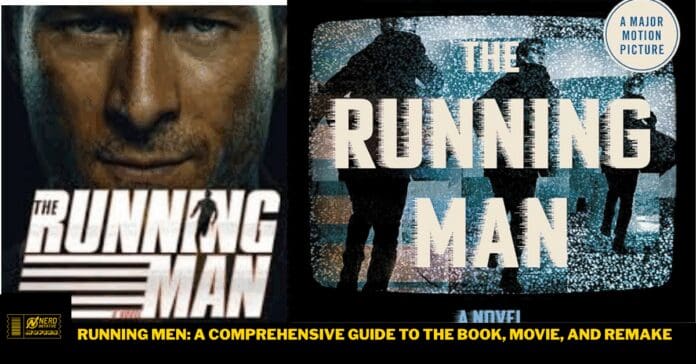
A recurring issue with Stephen King adaptations is that they are often misinterpreted. It’s widely debated if this is intentional or not. While King has worked with several directors on his adaptations, there are a good number where the premise is mostly intact, but its execution is bastardized. For every Christine and Cujo, there is an equally bad interpretation of Lawnmower Man and The Shining (yeah, I said it). As an adaptation, 1987’s The Running Man falls into the latter category. All three versions keep the game show plot intact, but there are, of course, differences in the execution.
The Benefit of Being Bachman
When Stephen King became a household name in the 1970s, it was common for authors to publish one book a year. Yet, he was writing at a much faster pace than that. King created the Richard Bachman persona so he could release more than one book a year. This allowed King to be more experimental, but also to confirm if people were buying his books for the story or the name printed on them. He used the Richard Bachman name until 1985, when it was revealed to be the pseudonym of the King of Horror himself.
The Running Man (1980)
The Running Man is Stephen King’s take on Richard Connell’s “The Most Dangerous Game,” with some modifications, of course. The book takes place in 2025, and the country has gone to hell. Disease and poverty are rampant, and one of the ways to make money is to go on the Games Network in Co-op City and play televised game shows with varying degrees of risk. These range from something as innocent as “Treadmill to Bucks” to as treacherous as “Swim from Crocodiles”; the more danger, the more money. This is something Ben Richards needs to consider to keep his wife, Sheila, from turning tricks to get meds for their sick daughter, Cathy.
Ben gets selected to play in “The Running Man,” the Games Network’s most popular show. All he has to do is evade a group of hitmen for thirty days, and he can win up to one billion dollars. They give him a twelve-hour head start before he is declared an enemy of the state. The longer Ben evades, the more money he wins for his struggling family.
This is King riffing on the classic, socially conscious science fiction authors that informed a lot of his own views. It does what all good science fiction does well: become somewhat accurate in its predictions of the social, economic, and morals of its supposed hypothetical future. The first third of the book is a meditation on sci-fi’s tropes of warnings and “what ifs?”
Given the poor living conditions and economic status of the citizens in the United States, their attitude towards the government and fellow man is not at its peak. Tensions poke through in a myriad of ways. It’s not early Stephen King without him dropping casual racism and sexism. I used to think this was a crutch for King: vile phrases used by his villains hyperbolically to contrast good characters from bad. Unfortunately, it works for a future (read: present) where being edgy is the norm, which makes this good Sci-Fi, but is it that far off? It’s vicious, and that’s what makes it sadly accurate.
The Running Man (1987)
The original film was directed by Paul Michael Glaser and written by Steven De Souza, who adapted it from two sources and starring Arnold Schwarzenegger: King’s dystopian novel and the French film, The Prize of Peril. Gone are Ben Richards’ prostitute wife and dying kid, and present is Ben Richards, the soldier who would not shoot civilians protesting food. Regardless of his defiance, shots are fired, and Richards is framed and dubbed “The Butcher of Bakersfield.”
After a botched attempt to escape authority, Richards is captured and forced to participate in “The Running Man” for his crimes. This game pits contestants against a slew of meatheaded death bringers with names like Subzero, Dynamo, and Buzzsaw, where survival is key. This is closer to what American Gladiators would be a couple of years later, with much, much less killing.
Yet, while it fails as a Stephen King adaptation, it succeeds as an action movie. By the time this movie had been released, Schwarzenegger was a star, and it leans on the audience knowing that going in. Stephen King said that the Ben Richards of his book is the exact opposite of Schwarzenegger: physically, socially, and with different motivations. Schwarzenegger’s star power was probably the reason it got made. The movie is full of character actors who held down the fort in plenty of movies in the 1980s and 1990s, with Kurt Fuller being the most recognizable. It even goes as far as stunt casting original Family Feud host Richard Dawson as Damon Killian, the host of the Running Man TV show.
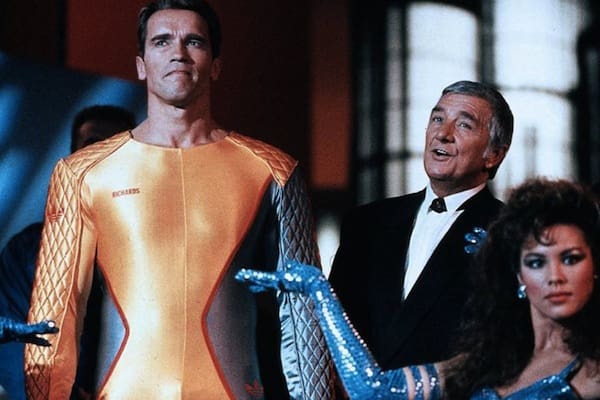
Even though King was outed as Bachman in 1985, his disdain for this movie had it credited to his pseudonym, feeling burned by another adaptation. The games are a punishment more than a last resort to poverty, which completely changes Ben Richards’s motivation. King’s and De Souza’s respective dystopias are two sides of the same coin. Glaser’s direction is well done even if the film didn’t get King’s stamp of approval. Its hyperbolized dystopia, mixed with the game show culture that was prominent in the 1980s, combined with the ever-emerging action genre, makes this a fun watch.
Edgar Wright’s remake (2025)
All of this makes Edgar Wright’s new adaptation particularly interesting in 2025. This last weekend saw its release, but not to as much fanfare as many would have hoped. It was a bit disheartening to see people whose movie opinions I trust not be enthusiastic about the film. While I have disagreed with some of the criticisms, I can agree that it’s not a perfect movie, but neither is the source material.

Wright’s film follows the book much closer than the original movie. It’s still hyperbolized, but so was King’s book. I think the trouble with King adaptations in general is that, for a multitude of reasons, they have been changed. Sometimes, due to length, or due to content, but even when films have stayed close to King’s material, people still complain. This happened to It: Part 2, and it happens here.
Wright’s commitment to keep as close to King’s book as possible is a double-edged sword. King’s writing sometimes has long valleys in them. Pairing those moments with Wright’s quick cuts and fast pace stalls the movie in some parts by honoring these moments. While this can lead to weird and sometimes inconsistent tone changes, a problem with Wright’s films that seems to be something to complain about now
Glen Powell works as an amalgamation of the original movie and novel’s Ben Richards. Throughout the movie, when the GCN reports to the billions of viewers watching “The Running Man,” they deep-fake the video to make Richards the heel, given his penchant for defiance. Yet, what I think is misinterpreted is the misaligned thought that Ben Richards is cocky, and not disillusioned to the point of mental instability. His habit of losing jobs for insubordination is tied to the health and safety of his co-workers rather than issues related to ego or a horrible work ethic.
Wright’s dystopian future seems closer to the world of the 1993 Super Mario Bros. movie than to Blade Runner, but Wright has a way of pulling from the films he loves. The moments where Ben Richards has to get into character to disguise himself from being caught feel reminiscent of Chevy Chase’s similar scenes in Michael Ritchie’s Fletch. I think people go into this film looking for science fiction which there are elements of, but this is an attempt at satire and a statement that gives Falling Down vibes more than anything.
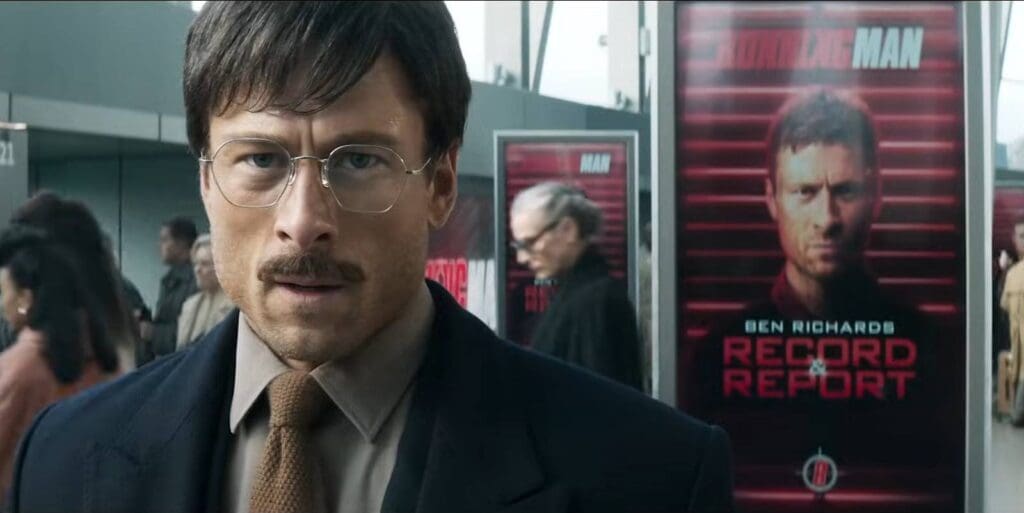
Wright did what Mike Flanagan had to do with his adaptation of The Shining sequel, Dr. Sleep: honor both the book and the movie despite King’s opinion on it. This new version does a great job of bringing in elements from the book and the movie to the screen. There is a lot more crossover than you would think, considering King was not a fan of the original movie. The new movie even kind of hits the ending of both versions in its own way. If you’ve read the book, you know there is no way that ending would fly in a post 9/11 America (no pun intended), which is surprising when this movie almost does in its own way.
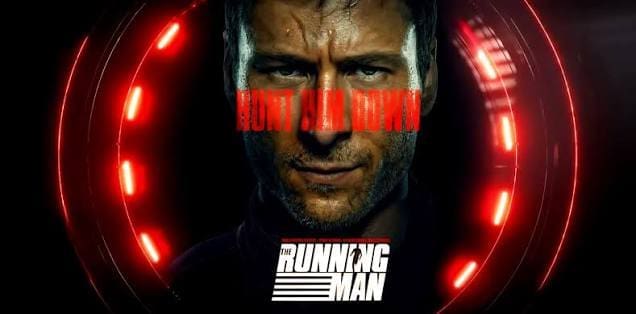
Each of the versions of The Running Man works in their own way. The Venn diagram of plot points and themes cross in different ways, making each one a variation on the same themes. Each version has its merits and works in different ways. Whether it be a famous novelist’s take on the stories of his Sci-Fi heroes, a vehicle for a rising action star, or an established director’s attempt at satire. The story of The Running Man has themes that have been presented to us ad nauseam, but never seem to resonate. Unfortunately, we’ve reached a point where these supposed fictional dystopias are inching closer and closer to reality. If we’d only learn the first two warnings.
See Forrest’s review of Nobody 2 here

Leave a Reply