
Mike Flanagan’s take on the Stephen King classic hits some very high highs, but unfortunately its desire to bring something new to the story falls flat.
In a world rocked by constant reboots and remakes of classics, it was only a matter of time before someone tried yet again to put their own spin on Carrie. Published in 1974, the book has already received three film adaptations; most notably the 1976 adaptation starting Sissy Spacek in the titular role. This new adaptation aims to bring something new, namely by updating it into a 21st-century story. The result is something truly special, albeit with some questionable plot changes.
Plot spoilers for the first season follow.

Carrie in the Age of Social Media
Carrie takes the source material and brings it into the present day, adding a brand new layer of the torment Carrie White (Summer H. Howell) faces in the form of an anonymous Instagram account. The account, created in secret by Christine Hargensen (Alison Thornton), serves as a way for the students and faculty of Ewan High School to air grievances and, yes, spread rumors about each other.
The account’s name, Carrie Red, is spawned out of the infamous “Plug It Up!” scene, where Chris and other girls throw tampons at Carrie in the gym shower after she unexpectedly gets her first period. The scene is one of the most recognizable in the 1976 film, and I was pleased to see that the effect remained the same in this new adaptation. Watching the entire class pull out their phones to record a terrified and soaking wet Carrie breaks the heart of anyone who’s received any form of online harassment.
I went into this adaptation as blind as I could, and I was pleasantly surprised by this new approach. While social media bullying is not a new topic in media, it still feels rare to see a show that lays out the consequences in such a brutal, tragic way. There are no winners or losers in this battle. Every character suffers immense loss at the end of these eight episodes – some more than others. Rather than making this a story of Carrie versus Everyone, Flanagan turns it into a story of Everyone versus Themselves. The students are failed by the adults, the parents are failed by the school, and the school is failed by an administration that waits until it’s too late to try and fix the problem. The result is a cautionary tale about what kind of tragedy can happen when harassment of this level goes unchecked.
A Family Affair
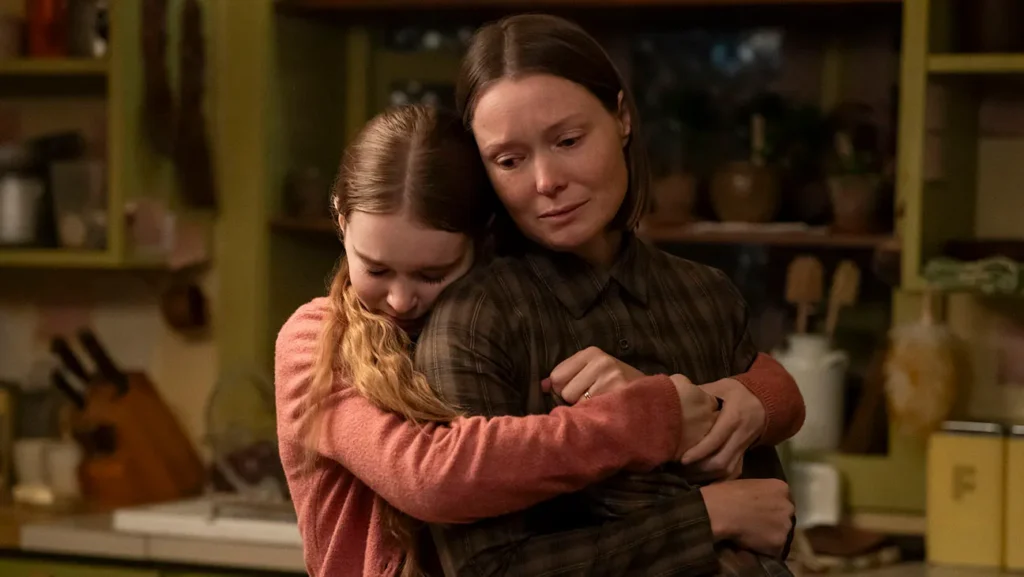
One of the highest points of this adaptation is the dynamic between Carrie and her mother, Margaret (Samantha Sloyan). Margaret’s religious fanaticism and desperation to keep Carrie safe from the dangers of the world are still there, but there is a quiet, calculating way she approaches her goals when compared to the source material. Gone are the scenes where she screams at Carrie for being “unclean” for starting her period. Instead, she becomes the figurehead of the anti-bullying campaign, creating her own Instagram account under the name “RealMaggieRed”. It looks like good parenting on the outside, but deep down it is just a way for her to further her own agenda.
In a way, this new take on Margaret is more terrifying than the original. We watch her fight to bring her daughter’s tormentors to justice and root for her – how many of us have watched a friend or family member suffer at the hands of a schoolyard bully? I even wondered, for a moment, if Margaret’s abuse of Carrie was going to be glossed over or even written out entirely. This makes those moments when Margaret snaps at Carrie for standing up for herself and wanting to experience the world hit even harder. In one particularly intense moment in episode six, Carrie breaks down in front of her mother and says she might have mental health issues, only for her mother to scream at her that mental health isn’t real and is a construct created by the healthcare industry. Margaret not only serves as a representation for those who would rather stick their head in the sand rather than face the hardships of the world, but also for all of the parents who hurt their children under the guise of “good parenting”.
A Team of Superheroes
For all of the high points of this adaptation – from the updated setting to the expanded personalities of our side characters – there is one piece that unfortunately serves to bring it down a peg: the introduction of Emaline.
If you’ve read the original book by Stephen King, you know that it is heavily implied that Carrie is not the only one with powers. This fact is expanded on in Flanagan’s adaptation. Along with the post-prom interview with Sue Snell (Siena Agudong), where she is pushed to remember any weird sights, sounds, or smells from that night, Carrie’s powers are even explicitly referred to as “the shine”. Readers of King’s work will know that many of his books are connected, and while the original Carrie did not exist in a universe alongside others, it does make sense that Mike Flanagan would incorporate that widely recognized term. That, and the episode intros that tell stories of other special women throughout history, work to place Carrie into a broader world.
What doesn’t work is the decision to turn Carrie into the newest member of what I can only describe as “Stephen King’s X-Men”.
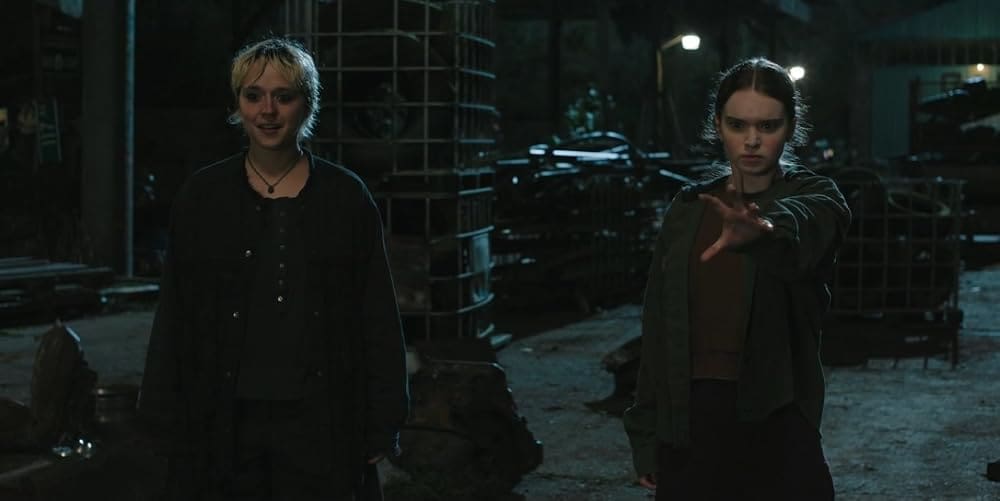
Enter Emaline, a character who mysteriously introduces herself to Carrie in the school bathroom as “the last new student”. She pops up constantly, offering advice to Carrie regarding school and, eventually, her powers. It doesn’t take long for us as the audience to realize that Emaline isn’t actually there, at least in the physical sense. Carrie’s classmates realize this too when Chris and Billy (Arthur Conti) leak a video from a home security camera inside the White’s house of Carrie talking to herself.
On the surface, this could work – the idea of watching Carrie descend more and more into madness as she tries to figure out what, or who around her is real, could have worked very well. However, the show goes a few steps too far by making Emaline, in my opinion, more involved with the central plot than she ever should have been.

Happy Prom
We all know how Carrie ends, and I, for one, sat with bated breath through the first seven episodes, waiting to see how Mike Flanagan would tackle one of Stephen King’s most iconic moments. The scene, for the most part, progresses as it does in other adaptations. Tommy (Joel Ouelette) takes Carrie to prom; they win prom King and Queen (in this version, thanks to some sneaky IP-Hopping by Chris and Billy), and our two aforementioned bullies dump pig’s blood on her during the ceremony. The students look on in shock and horror, until they begin to pull out their phones, laughing and recording. The stage is set for Carrie, who has been endlessly harassed for a semester, to take her revenge.
Enter Emaline.
After accidentally killing Tommy in an attempt to get Chris and Billy off of the catwalk, Carrie almost snaps out of her anger, overcome by grief at the loss of one of her only real friends. Emaline appears and asks Carrie to let her take over this next part.
Yes, you heard that right – Emaline possesses Carrie and proceeds to set the gym ablaze, killing almost all of the prom attendees, before leaving and dancing down the street. It’s not until Emaline, wherever her real body is, is shot (a moment that we get no answers about) that the connection severs, leaving Carrie alone to deal with her actions. She stumbles home, drenched in blood, for one final confrontation with her mother, who, surprisingly, also has powers! They fight, and unlike in the original, the show doesn’t end with them dying. Instead, Margaret is brought in for questioning and then killed by yet another character with powers, while Emaline and Carrie drive off together in search of a new life.
You know when you can tell that a show is desperately trying to get renewed for another season? That’s exactly what this felt like, and I think that’s why the ending felt so flat. I’ve always described Carrie as a tragedy, a story of a girl who was failed time and time again, and who ultimately met a tragic end as a result of her own rage and sadness. To strip that away, including taking any blame for the massacre at prom and passing it off to someone else, feels almost insulting to the source material. What is so wrong about letting a girl go crazy and kill all of her classmates?
Final Thoughts
When I first watched the 1976 adaptation, I fell in love with this story, a love that was only reinforced when I finally got my hands on the book. For that reason, I felt incredibly excited about this adaptation, especially with Mike Flanagan at the helm. When this adaptation hits, it really hits. You care for these characters, due in large part to the amount of time we spend with them. Despite some very questionable plot changes, Mike Flanagan has crafted a beautifully emotional piece about the horrors of adolescence. Whether you agree or disagree with the changes is entirely up to you.