

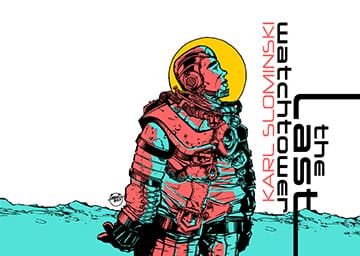
For his newly released comic, The Last Watchtower, Karl Slominsky had a relatively simple approach: one finished page a day with no plans, no script, no layouts, no revisions. What started as a way to kill time during the initial lockdown of the pandemic eventually became a habit, and a way to escape COVID’s uncertainty. That uncertainty takes the story to a new level regarding structure, tone, and pacing. Slominsky’s story about a voluntarily isolated astronaut forced to reckon with his past through extraordinary events says more about mental health and grief than any therapist can.
Dystopian Grief
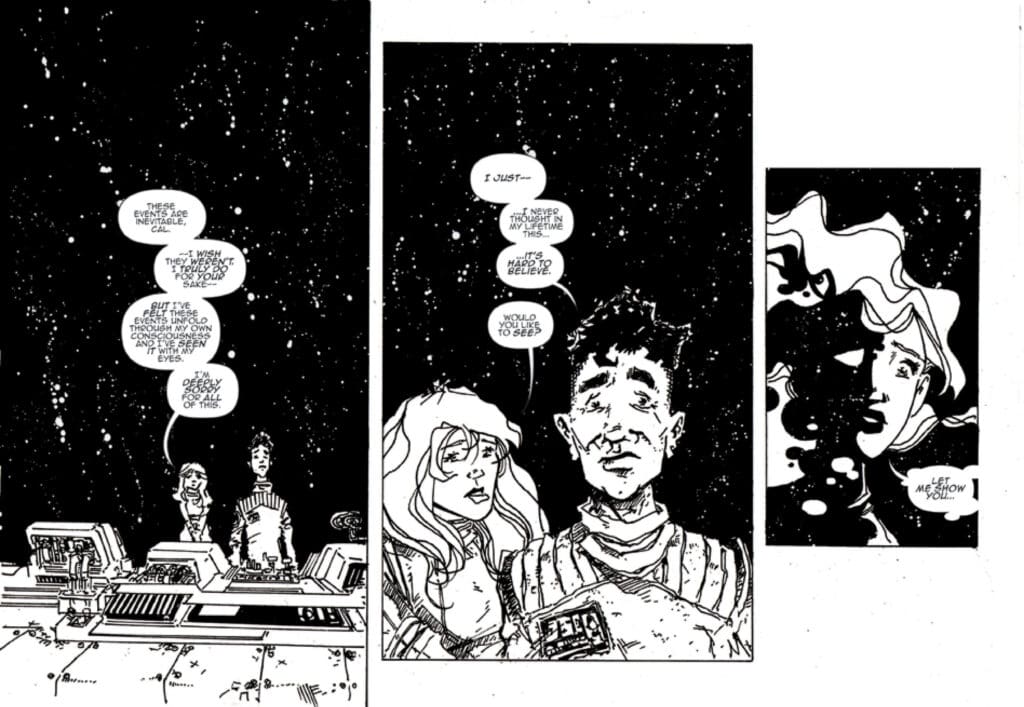
Years after his family was killed in a meteor shower, Cal Ferris lives on an isolated observation station in space to observe and report violent events on Earth. While he is alone in the material sense, Cal is able to speak to the space station’s AI computer. His life is put into a tailspin when he finds another ship floating in space with a sign of life: Vaya. Vaya ends up disrupting Cal’s self-narrative of avoidance to face the past, present, and future of his grief and his self-assigned punishment.
Narrative Experimentation
The Last Watchtower may seem like your typical run-of-the-mill twisty sci-fi story, but beneath its surface is a story of loneliness and the feeling of catastrophe we get every time we turn around. While Slominsky’s approach gives this story an odd shape in its pacing and sometimes abrupt transitions, it definitely works. I think knowing the improvised nature of how the story came together gives you the hint that even Slominsky had no clue what was coming.
Slominsky’s framing of the story with Cal’s letters to his dead wife is an interesting take on the whole concept of a captain’s diary. His mourning makes him more vulnerable the longer he stays up in space and makes him more emotionally unstable; as much as Slominsky’s vulnerability can be on display, the longer the narrative of his comic lasts.
Cal may want solitude to deal with his grief, but he does everything in his power to not deal with it until the power is no longer in his hands. The same can be said for Slominsky’s process. However, the universe doesn’t give us what we want, but what we need. Slominsky’s improvisational method doesn’t just shape the comic, but mirrors Cal’s unraveling.
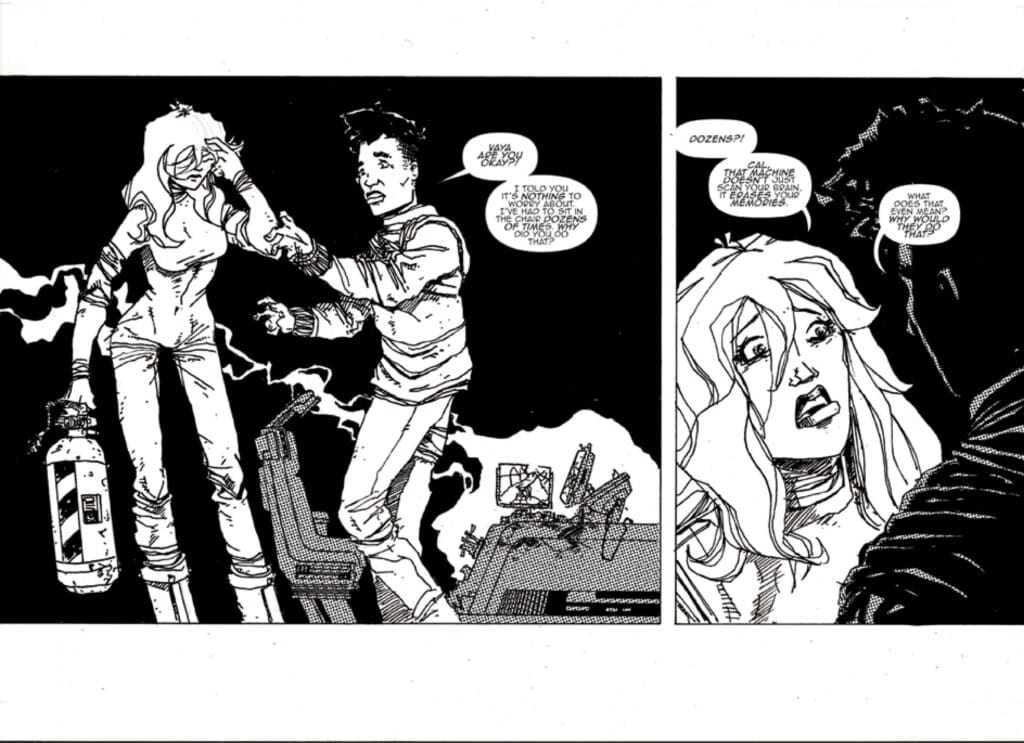
Slominsky’s self-imposed rules led him to do the drawings in only ink. The whole book is in black and white, and has a very 1950s space cadet feeling to it, aesthetically closer to something like Fear Agent meets The Underwater Welder. The lack of color reinforces Cal’s emotional numbness while the AI companion reflects coping mechanisms that dull Cal even further. It feels like it gives the story permission to live in that Twilight Zone type of storytelling. Using the violent tragedies that plague Earth as a hyperbolic way to eulogize the growing number of COVID deaths while writing makes sense in that Rod Serling way to put things into perspective.
Overall Grade 8/10
The Last Watchtower isn’t perfect, and that’s very much by design, but it doesn’t need to be. While there are plenty of warts to find as it gets to its ending, they do not distract from the story. Karl Slominsky’s surreal trip into grief, isolation, and how they both lead to mental destruction says a lot in its one hundred fifty-ish pages. The concept and method of storytelling is a fun experiment that pays off well. The Last Watchtower is a slow-burn fantastical sci-fi horror story that pushes the genres with its structure while having something poignant to say about its under-the-surface themes. The Last Watchtower is out now on Black Panel Press.
Check Out More of Forrest’s articles here
